FROM DATA LAKE TO CEO DASHBOARD
Make Enterprise Data Part of the Operational Picture
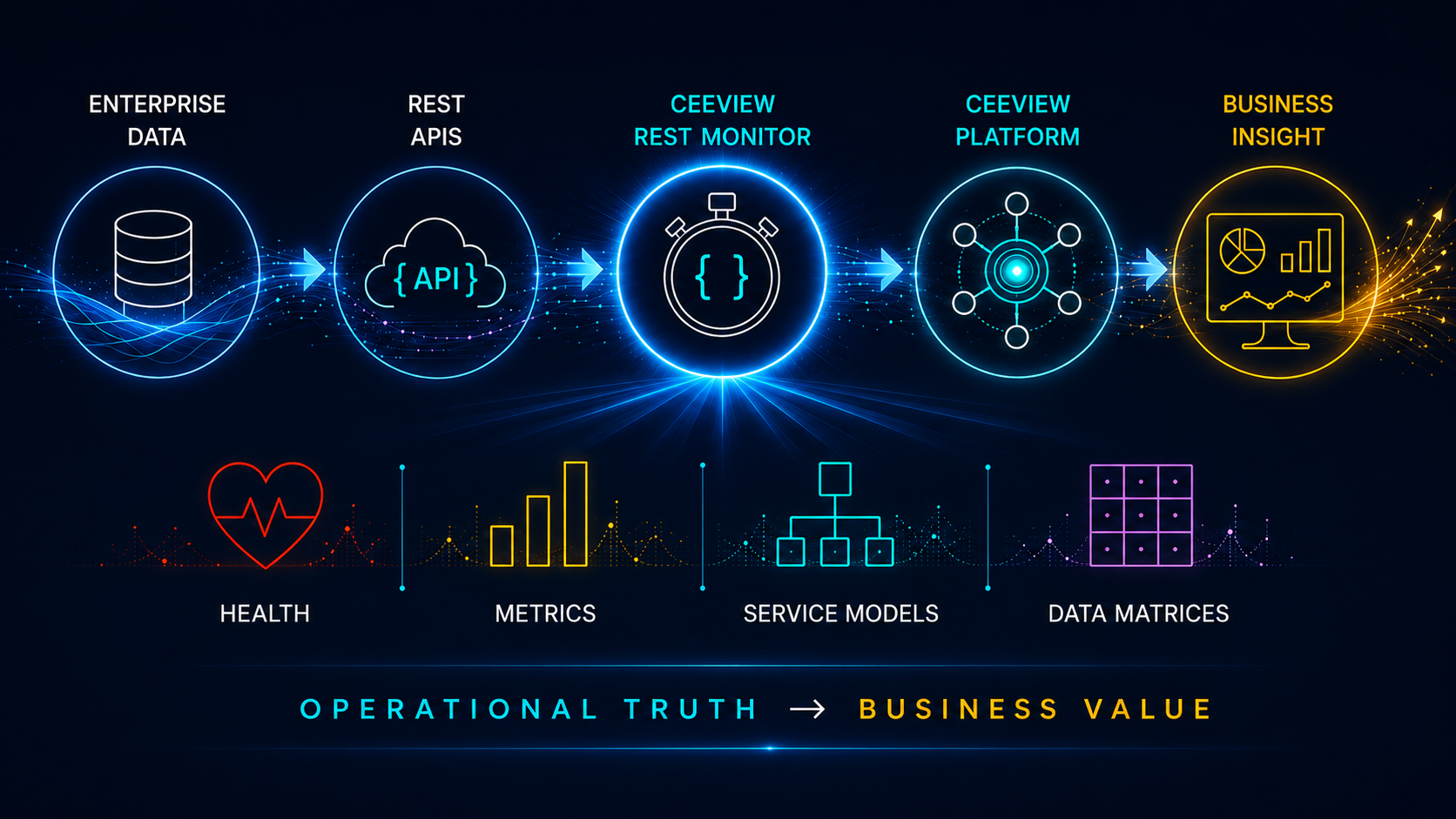
Organizations already have valuable operational data distributed across infrastructure, applications, business systems, cloud services and data platforms. REST APIs provide a path to that data. Ceeview REST Monitor provides the bridge that turns it into operational context within the Ceeview platform.
Once there, the same source data can support multiple operational perspectives—from health and metrics to service models and data matrices—while contributing to the broader Ceeview picture of service health, SLA performance, cost and business insight.
REST Monitor connects existing enterprise data to a broader operational picture—and ultimately, to business insight.
THE VISIBILITY GAP
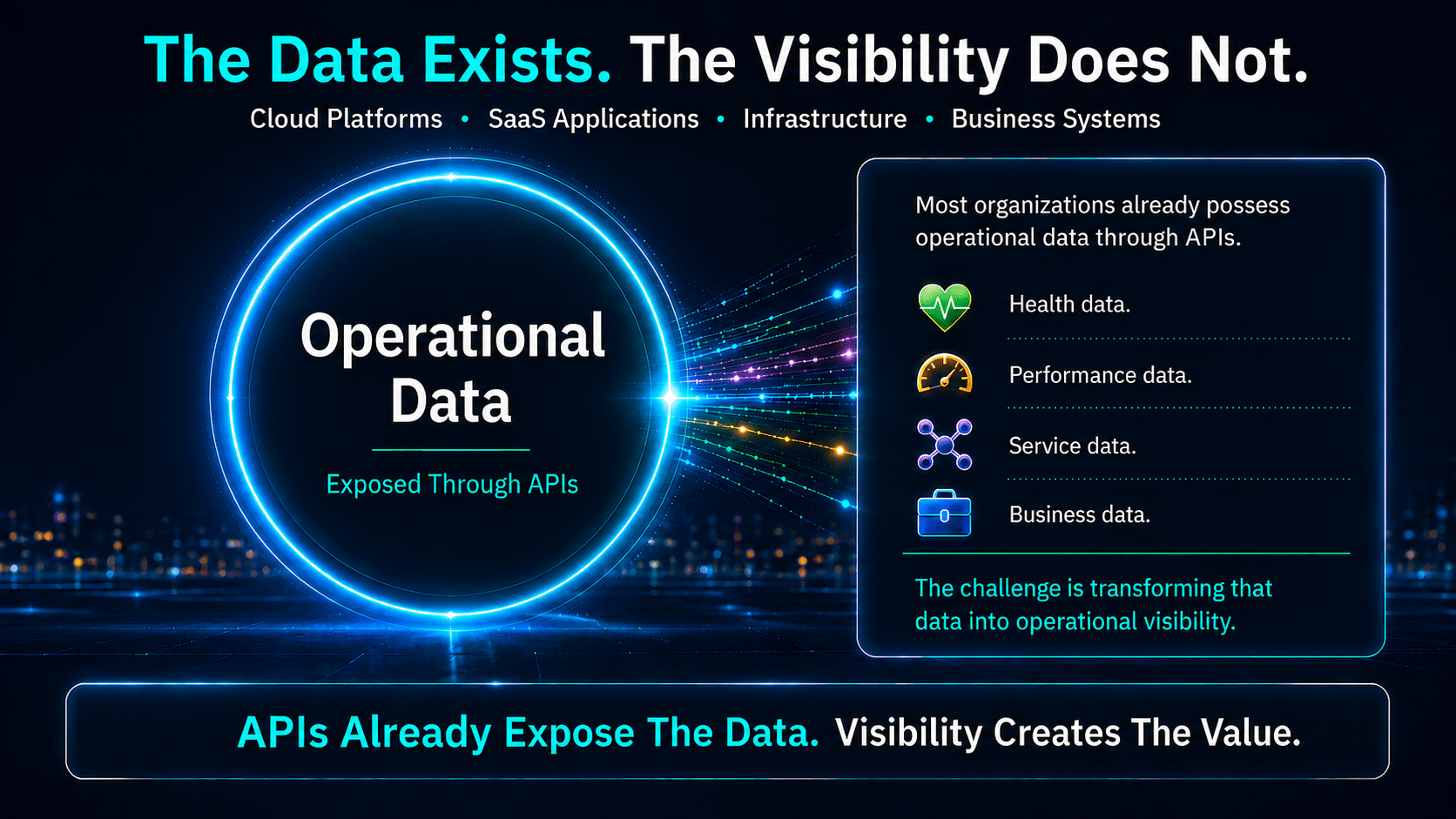
The Data Exists. The Visibility Does Not.
Azure. ServiceNow. VMware. Kubernetes. SAP. Nearly every system your business depends on already exposes valuable operational data through a REST API. Yet that data often remains trapped in raw JSON—available, but difficult for operational teams to see, understand, and act on.
Ceeview REST Monitor closes that gap. Its no-code visual workflow transforms REST API data into a connected operational model—in minutes, not days.
THE OPPORTUNITY
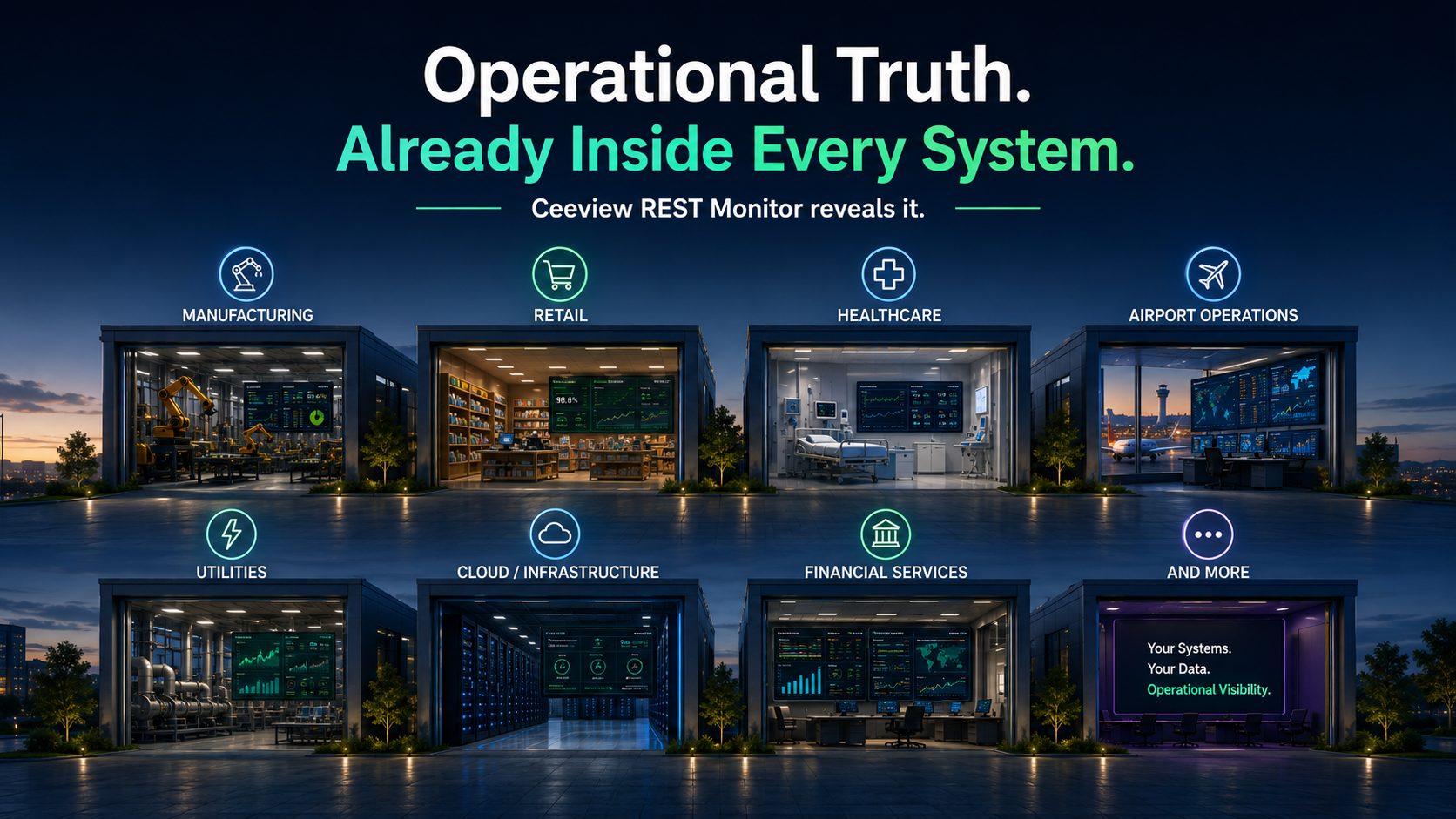
Operational Truth. Already Inside Every System.
Manufacturing floors. Retail networks. Hospitals. Airports. Utility grids. Financial platforms. Every operational environment runs on structured data describing health, performance, services, relationships, and business activity.
Ceeview REST Monitor is industry-agnostic. Wherever a system exposes that information through a REST API, REST Monitor can reveal its operational truth and make it visible in Ceeview.
HOW REST MONITOR WORKS
From Raw JSON to Native Ceeview Operational Objects
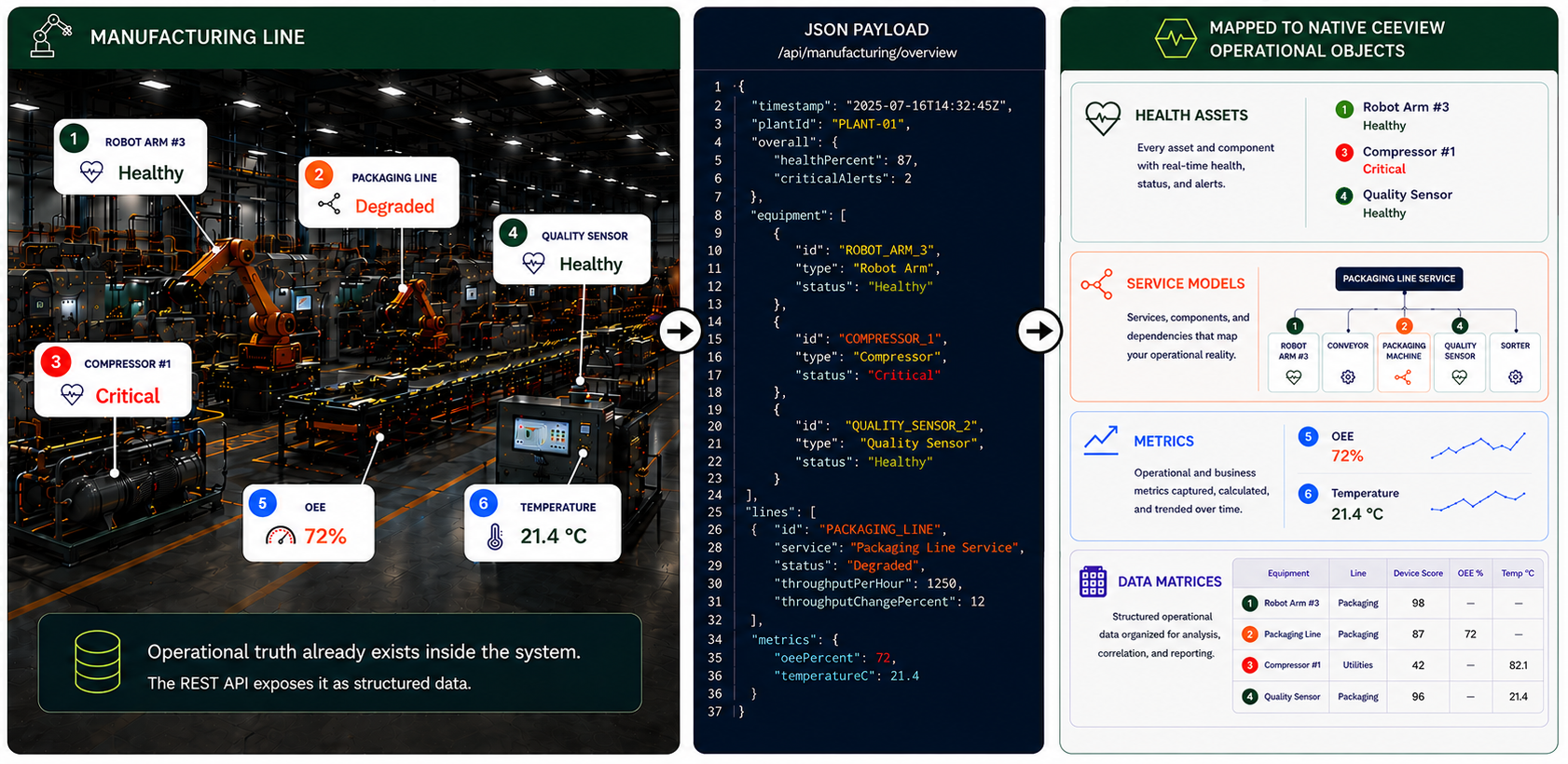
No traditional integration coding. In this manufacturing example, REST Monitor lets you visually discover, map, and transform fields from a JSON response — equipment identity, health status, performance values, and service relationships — using guided Producers.
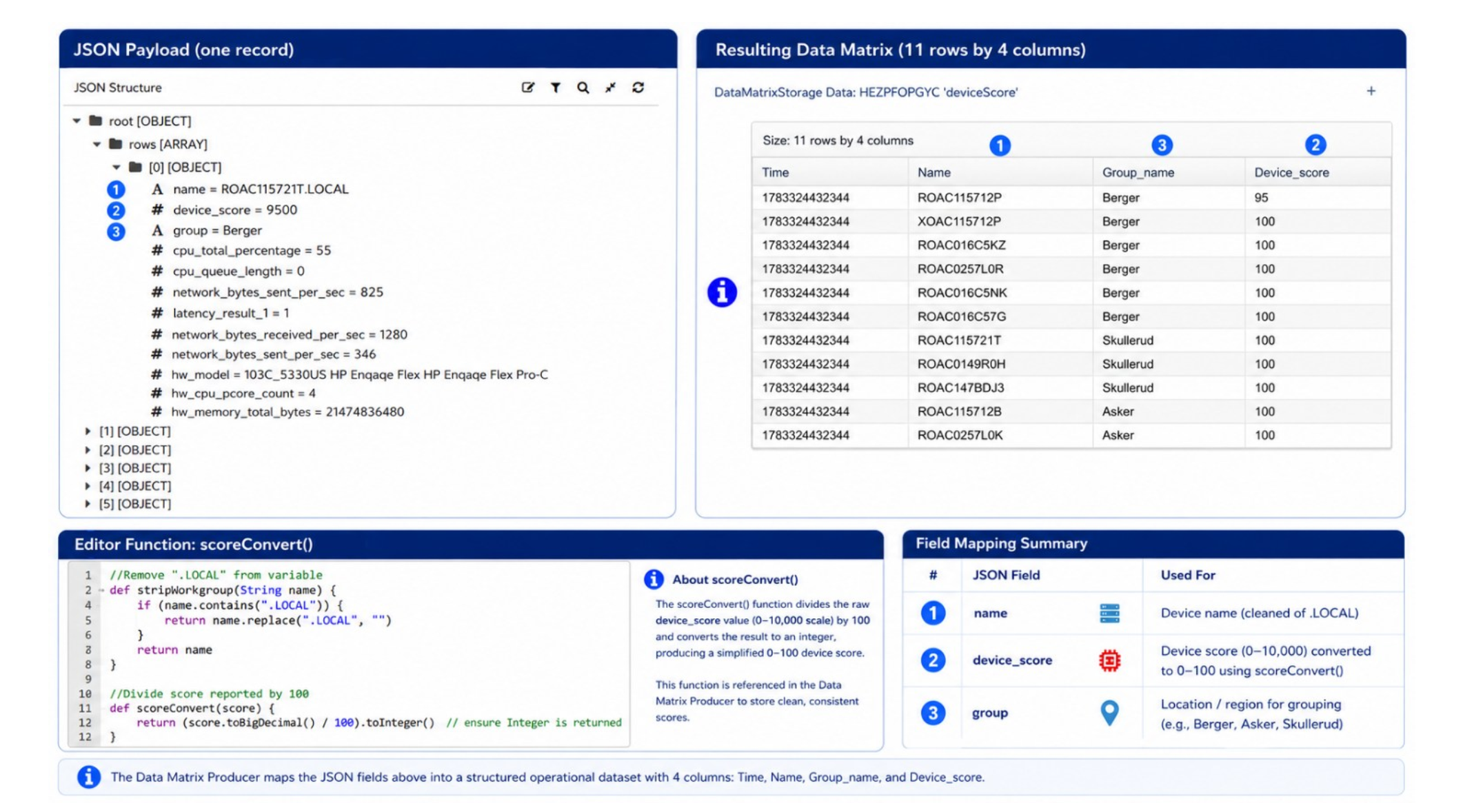
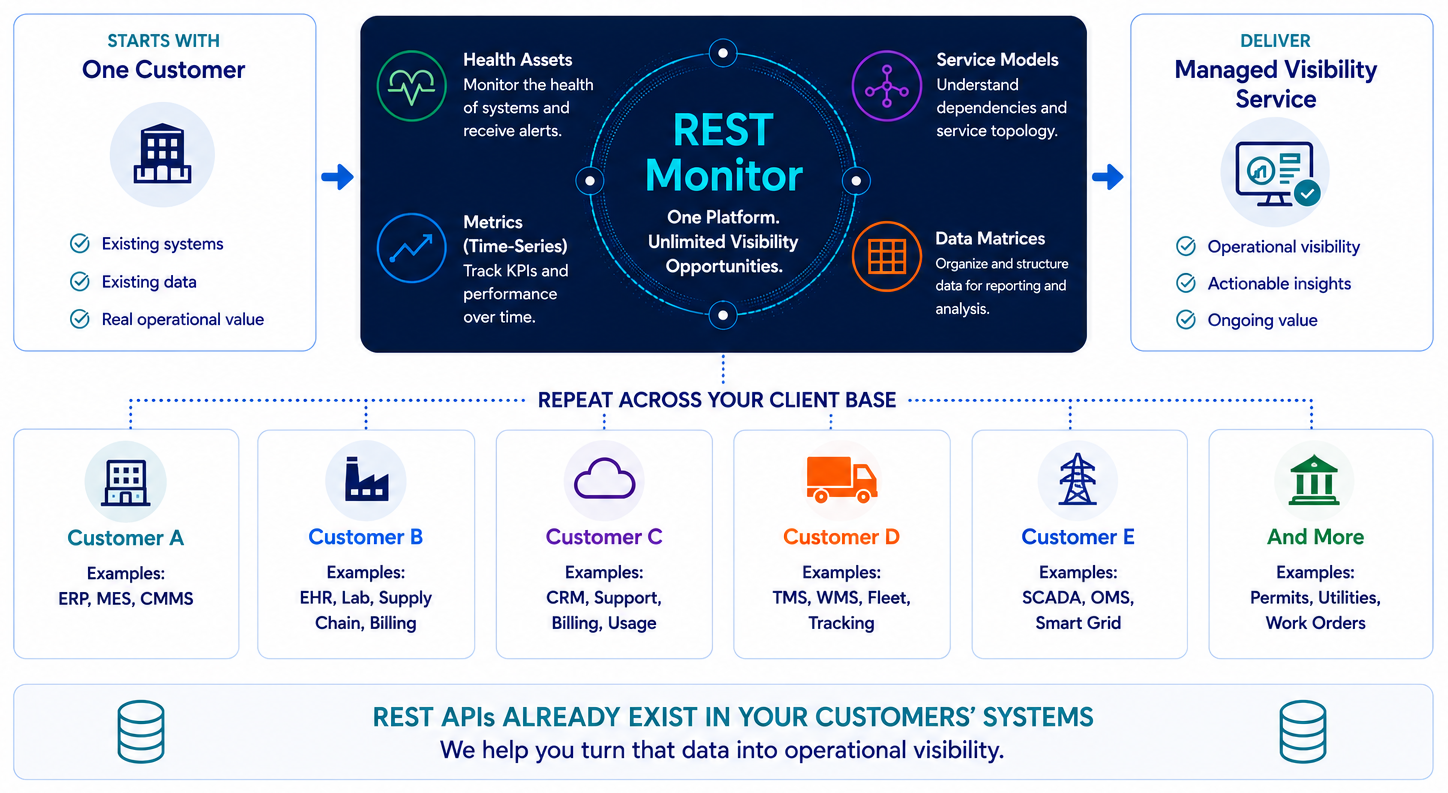
Each Producer is built for a different outcome. The Health Producer creates Health Assets and alerts. The Metric Producer creates time-series Metrics. The Service Producer builds Service Models and topology. The Data Matrix Producer creates structured Data Matrices for reporting.
Together, these four Producers turn one REST API into four connected operational perspectives — forming a continuously synchronized operational model of the system behind the API.
All four read the same underlying dataset, reused across every outcome. This is what minutes to visibility looks like.
REAL-WORLD USE CASE
Bridge the Gap Between Monitoring Worlds
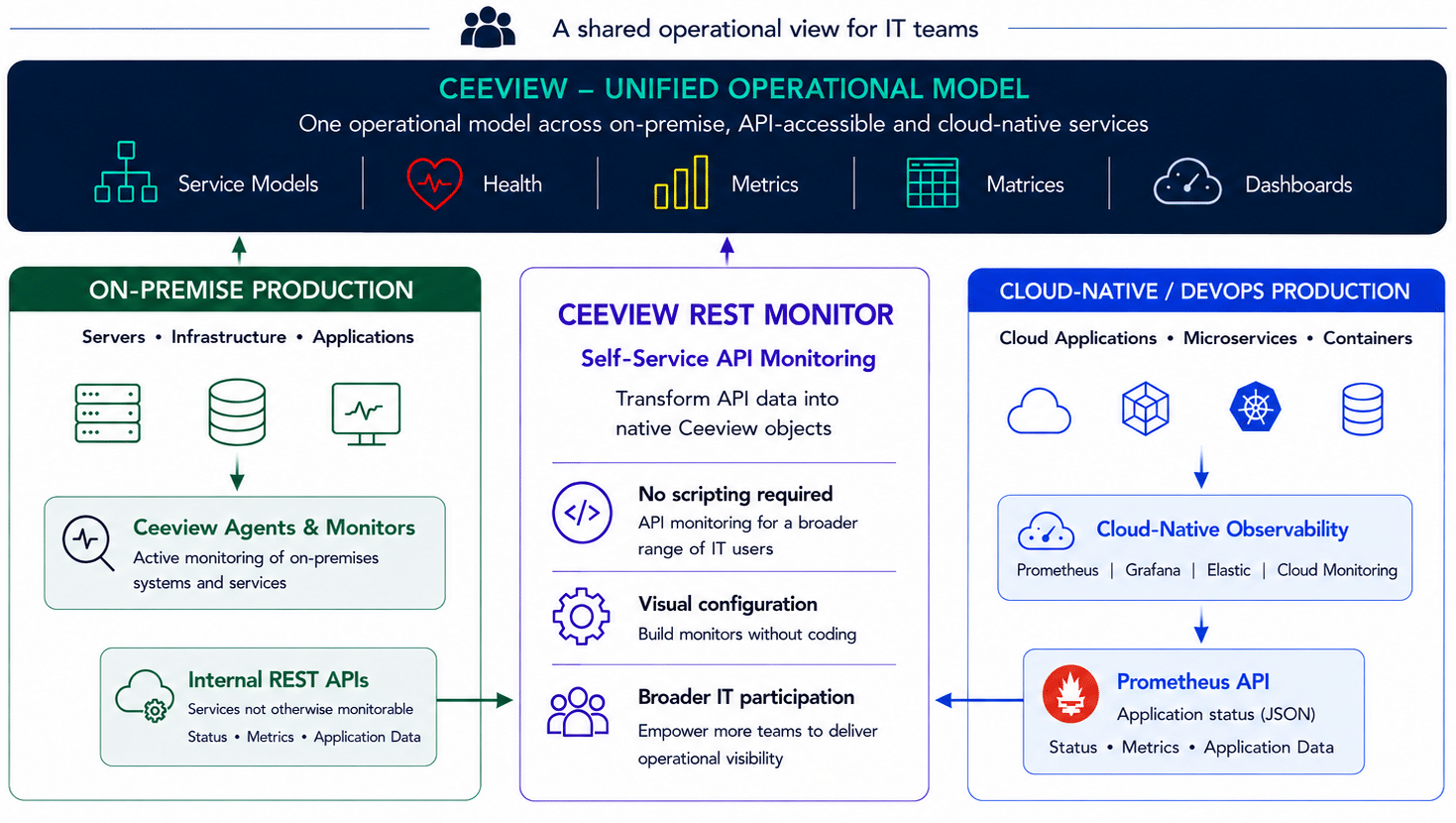
Bring cloud-native and API-accessible services into the same operational picture as on-premise monitored systems.
One environment. Different monitoring approaches. One operational view.
Modern IT environments rarely rely on a single monitoring approach. Operations teams may use Ceeview for comprehensive monitoring of on-premise infrastructure and services, while DevOps teams rely on Prometheus, Grafana, Elastic and cloud-native observability tools purpose-built for their environments. Rather than replacing those tools, Ceeview REST Monitor uses their APIs to bring the operational information that matters into a shared Ceeview model.
The same approach extends to internal applications and services that expose operational data through REST APIs but cannot otherwise be easily monitored. With visual configuration instead of specialized scripting, REST Monitor enables more IT users to bridge these monitoring gaps—giving Operations a broader view across on-premise, cloud-native and API-accessible services.
Build Your First Operational Model
Hands-On Learning in a Fictional Nordic Retail Environment
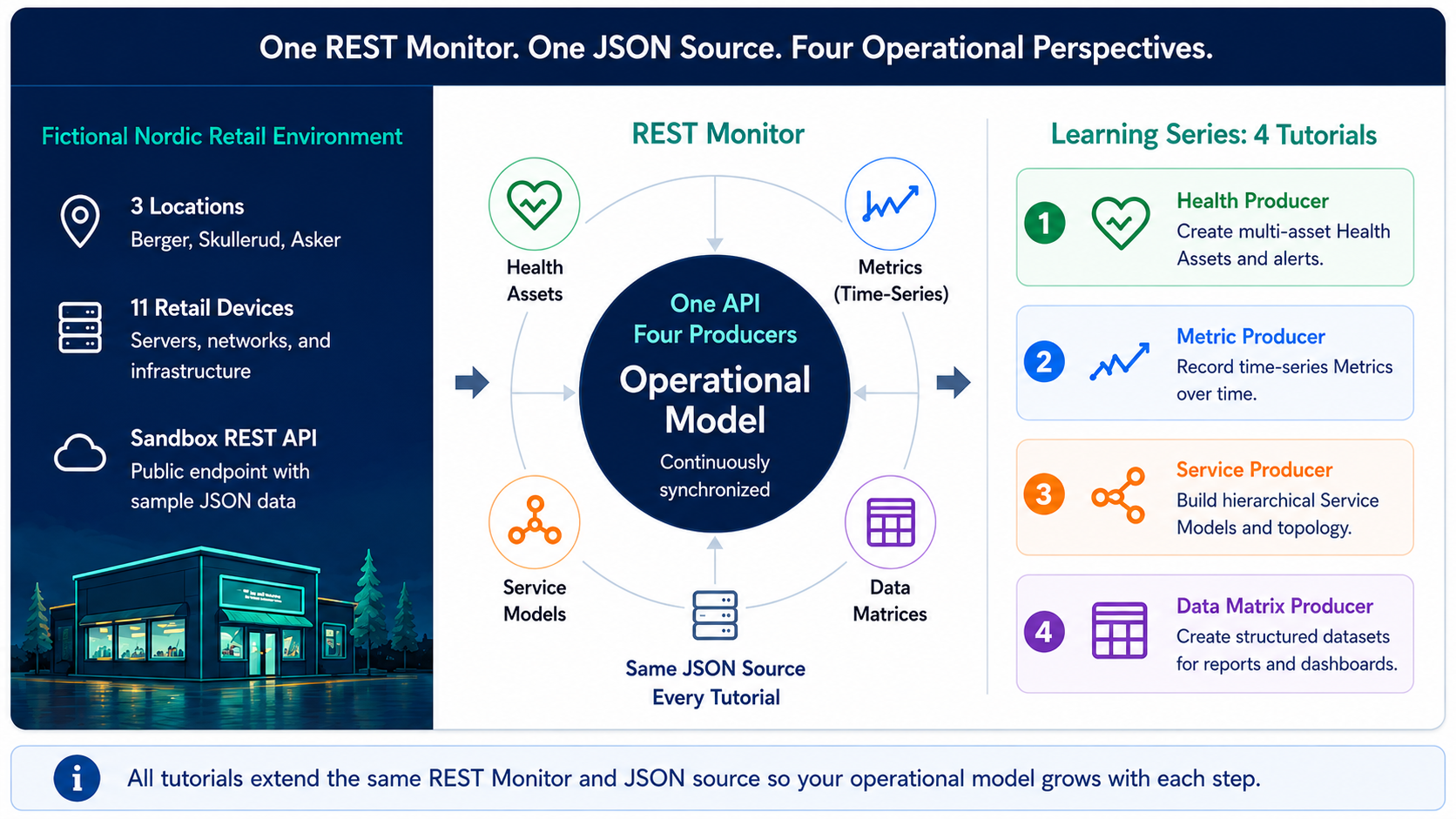
You’ve seen how REST Monitor can reveal operational truth inside a manufacturing environment. Now experience the same approach in a fictional Nordic Retail environment.
The four-part REST Monitor Learning Series guides you through one continuously monitored sandbox API representing eleven retail devices across three locations. Using the same REST Monitor and JSON source, you’ll progressively create Health Assets, time-series Metrics, hierarchical Service Models, and structured Data Matrices.

Explore the Learning Series
Preview the complete four-part path from raw JSON
to a unified operational model.
- Learning Series Overview
See the full roadmap and tutorial sequence.
- Tutorial 1: Health Producer
Create Health Assets from REST API data.
- Tutorial 2: Metric Producer
Generate native time-series Metrics.
- Tutorial 3: Service Producer
Build location and device Service Models.
- Tutorial 4: Data Matrix Producer
Transform API data into reusable datasets.
Start the Hands-on Experience
Register to get started with the REST Monitor Learning Series. A Ceeview team member will contact you with setup guidance and next steps.
See What You'll Build
Tutorial 3 — Build Connected Service Models
Map locations, devices, CPU, and Network data into hierarchical operational topology.
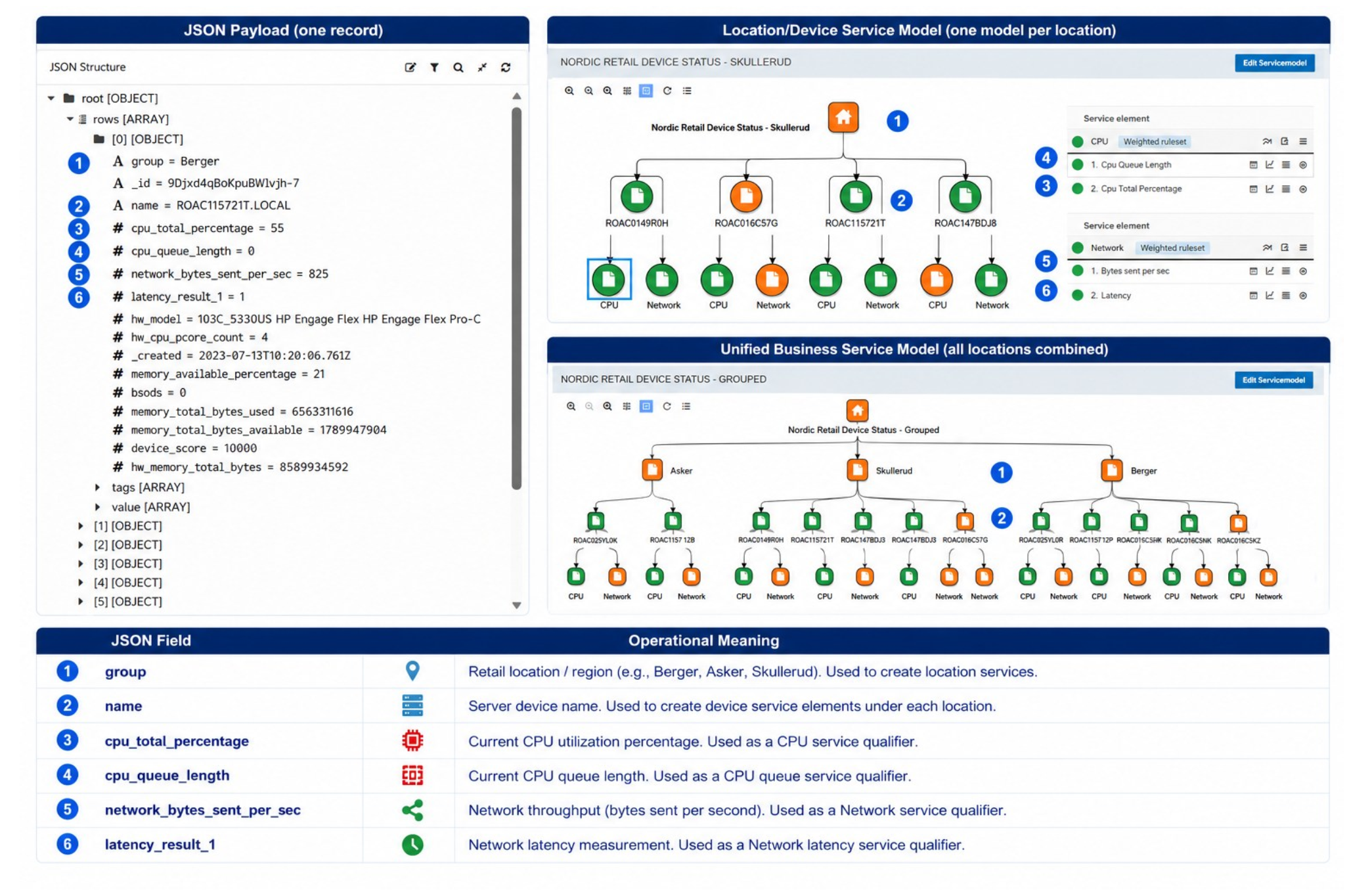
Tutorial 4 — Create Structured Data Matrices
Transform JSON fields into reusable operational datasets for reporting and analysis.
FOR MANAGED SERVICE PROVIDERS
Expand Your MSP Service Catalog with REST Monitor
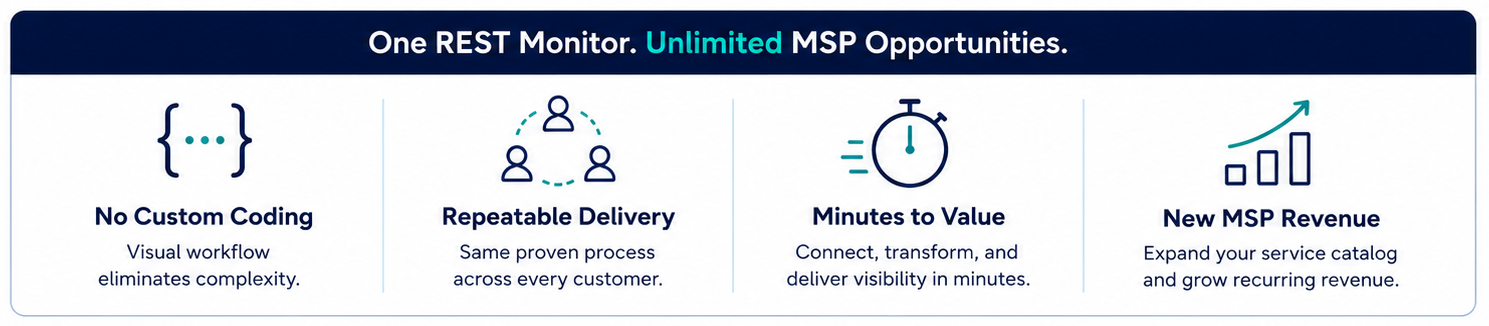
Turn the REST APIs your customers already own into repeatable managed services that deliver operational visibility—without custom development.
REST Monitor helps MSPs transform existing customer systems into repeatable operational visibility services—delivering value faster while creating new recurring revenue opportunities across every customer engagement.
Build Your Managed Visibility Service
Start with one customer, then repeat the same proven REST Monitor workflow across your entire client base.
Value for Your MSP. Value for Your Customers.
REST Monitor creates repeatable managed services that expand your offerings while delivering operational visibility your customers can immediately use.
Ceeview REST Monitor
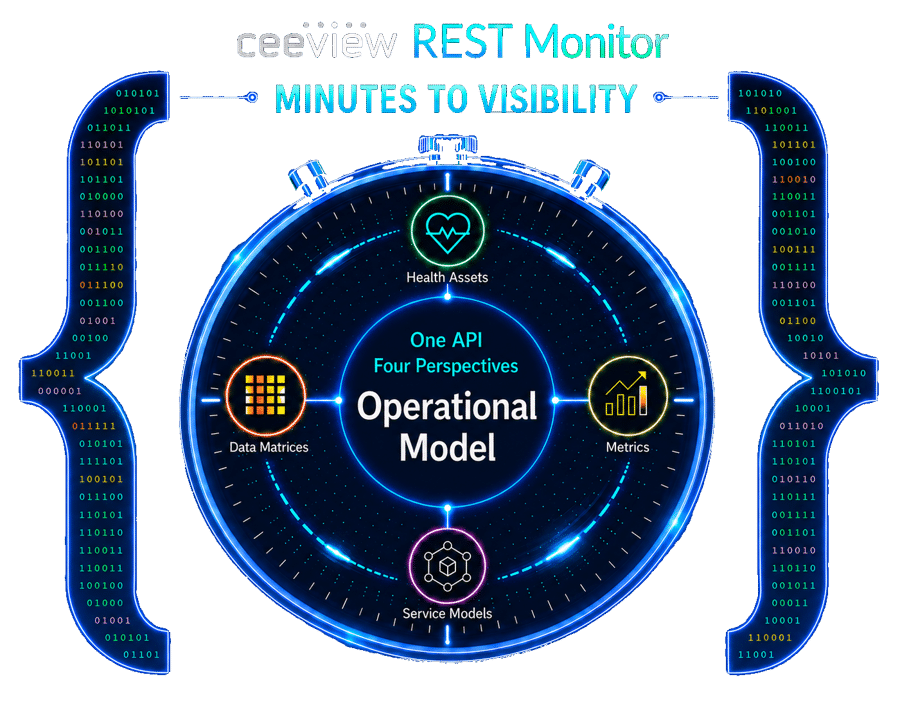
One API. Four Perspectives.
One Operational Model.
Reveal the operational truth already exposed through your REST APIs and transform it into connected Health Assets, Metrics, Service Models, and Data Matrices—without a traditional integration project.
Want the technical walkthrough? Read From API to Insight: Transforming External Data .
FAQ
What is Ceeview REST Monitor?
Ceeview REST Monitor transforms structured JSON from REST APIs into native Ceeview operational visibility. Through a guided visual workflow, teams can use the same API data to create Health Assets, time-series Metrics, Service Models, and Data Matrices.
Rather than stopping at data retrieval or visualization, REST Monitor continuously turns external API data into a connected operational model inside Ceeview.
Is REST Monitor an API availability or endpoint-monitoring tool?
REST Monitor can retrieve data from REST endpoints, but its primary purpose is not simply to check whether an API is available, measure latency, or report HTTP response codes.
Its focus is the operational information contained inside the JSON response—such as equipment identity, health conditions, performance values, business context, and relationships—and transforming that data into useful Ceeview objects.
This distinction is important because conventional API monitoring generally focuses on endpoint health, while REST Monitor focuses on converting API data into operational visibility.
How is REST Monitor different from integration, ETL, and BI tools?
Integration and ETL tools primarily move or transform data between systems. BI platforms usually import data to create charts, reports, and dashboards.
REST Monitor transforms API data directly inside Ceeview and creates operational constructs that remain connected to the source:
- Health Assets and alerts
- time-series Metrics
- Service Models and topology
- structured Data Matrices
The result is not simply another data pipeline or isolated dashboard. It is a continuously updated operational representation of the system behind the API.
What are REST Monitor Producers?
Producers define what selected JSON data becomes inside Ceeview.
The four Producer types are:
- Health Producer: creates Health Assets, health reasons, conditions, and alerts
- Metric Producer: creates timestamped Metrics for trending and historical analysis
- Service Producer: creates hierarchical Service Models, relationships, topology, and service qualifiers
- Data Matrix Producer: creates structured rows and columns for reporting, analysis, and reuse
All four Producers can use the same underlying REST API dataset, allowing one connection to support multiple operational outcomes.
How do the four Producers work together?
Each Producer provides a different perspective on the same operational domain.
Health Assets show current condition. Metrics show how values change over time. Service Models show relationships, hierarchy, and business context. Data Matrices organize the data for structured analysis and reporting.
Together, these perspectives form a continuously synchronized operational model of the system represented by the API.
One API. Four Perspectives. One Operational Model.
Does REST Monitor require coding?
REST Monitor is designed to avoid a traditional coded integration project.
Users visually retrieve, explore, map, filter, and transform JSON data through a guided interface. More advanced transformation logic can be added when needed, but teams do not have to build and maintain a separate scripting-based data pipeline before the information becomes usable in Ceeview.
The underlying product approach replaces the familiar workflow of external scripts, normalization logic, and disconnected pipelines with a guided workflow inside the platform.
What kinds of systems can REST Monitor connect to?
REST Monitor is designed for systems that expose structured data through a REST API.
Examples can include:
- cloud platforms
- SaaS applications
- infrastructure and network tools
- business systems
- custom applications and internal APIs
- industry-specific operational platforms
The system or industry is less important than the API response. When the payload exposes useful identities, values, conditions, classifications, or relationships, REST Monitor can map those signals into operational visibility.
Does REST Monitor continuously update the Ceeview objects it creates?
Yes. REST Monitor retrieves the configured API data on an ongoing schedule and updates the resulting Ceeview objects from the source.
This means Health Assets, Metrics, Service Models, and Data Matrices are not one-time imports. They can remain synchronized with the system represented by the API.
Can the same REST API support more than one operational use case?
Yes. This is one of the central REST Monitor design principles.
A single API source can simultaneously support:
- current health visibility
- historical performance tracking
- service and topology modeling
- structured reporting datasets
The data is retrieved once and shaped through multiple Producers for different outcomes.
What is the REST Monitor Learning Series?
The REST Monitor Learning Series is a four-part guided experience built around a fictional Nordic Retail environment.
Using the same sandbox REST API and REST Monitor configuration, participants progressively build:
- Health Assets
- time-series Metrics
- hierarchical Service Models
- structured Data Matrices
The tutorials demonstrate how one JSON source can be reused to build four connected perspectives of the same operational environment.
How do I determine whether an API is a good fit for REST Monitor?
A promising API usually exposes one or more of the following:
- identifiable assets, services, locations, or entities
- health or status fields
- numerical values that should be trended
- relationships or hierarchy
- structured records useful for reporting
- information that teams currently cannot easily see or operationalize
The best starting point is to inspect a representative JSON response and identify what operational questions the data could answer.