Most organizations have no shortage of API data—but turning it into something usable still means coding and maintaining fragile pipelines. The Ceeview REST Monitor introduces a guided, no-code workflow that transforms external data into dashboards, health signals, service models, and metrics. Discover how this model shifts teams from fragmented integration to structured, reusable insight.
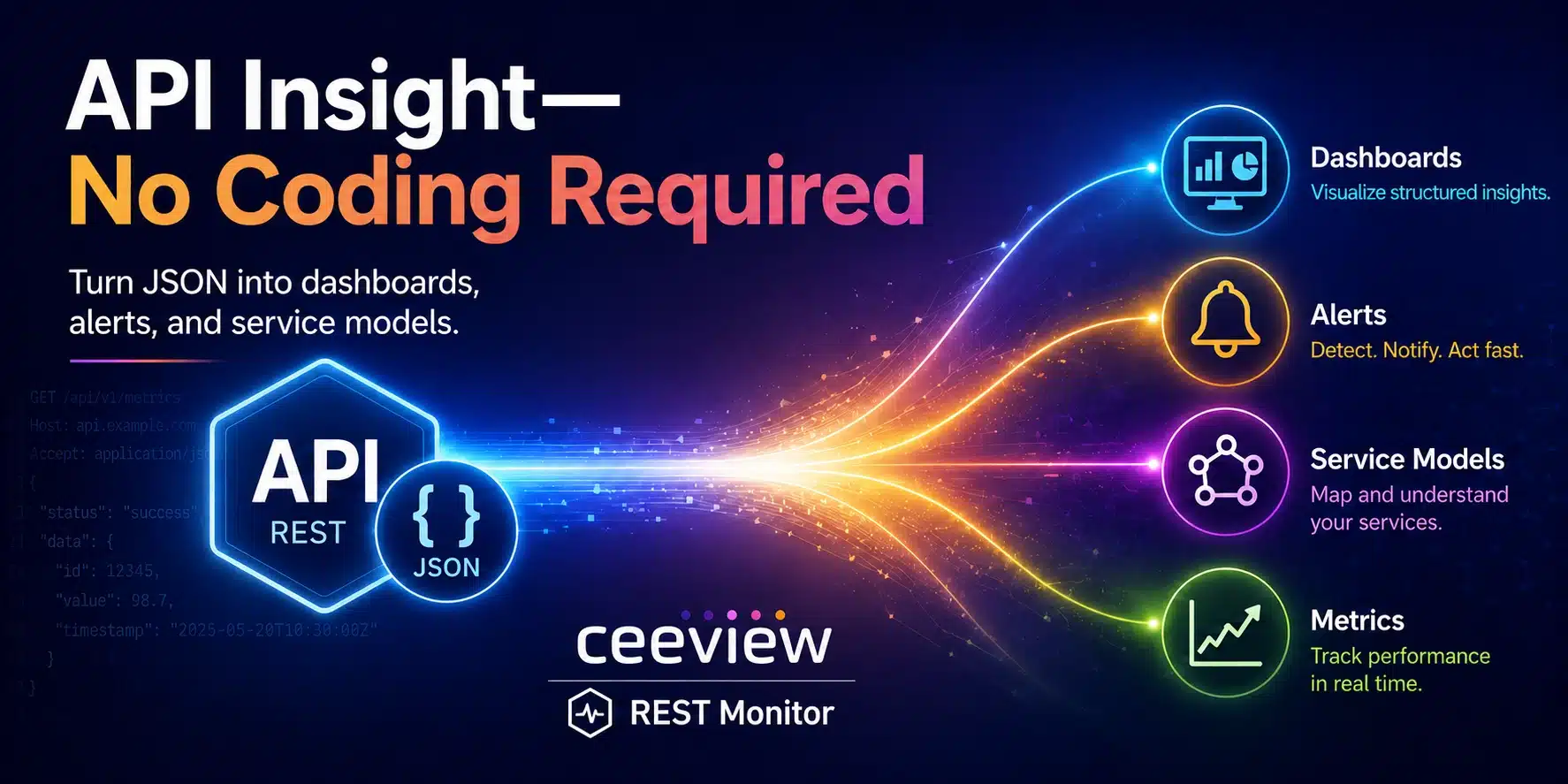
Organizations today are surrounded by data.
Every system—cloud platforms, SaaS applications, infrastructure tools, business systems—exposes valuable information through APIs. Yet despite this abundance, most teams still struggle to turn that data into something meaningful.
Not because the data isn’t available.
But because integrating and shaping it remains too complex.
The Problem: Integration Still Means Scripting
In many environments, working with external API data still follows a familiar pattern:
- Connect to an API endpoint
- Retrieve JSON responses
- Write scripts to extract and transform data
- Normalize and map it into usable structures
- Maintain that logic over time
This approach works—but it comes at a cost:
- Heavy reliance on scripting and developer skillsets
- Fragile integrations that break with change
- Disconnected data pipelines outside the monitoring platform
- Slower time to value for new use cases
The result is that external data often remains underutilized, even when it holds critical operational insight.
A Different Model: Connect. Transform. Deliver.
Ceeview’s REST Monitor introduces a fundamentally different approach.
Instead of scripting-first integration, it provides a guided, UI-driven workflow that brings external data directly into the platform:
- Connect to any REST API
- Retrieve structured JSON data
- Transform that data visually
- Deliver it into Ceeview as operational intelligence
This isn’t just about simplifying integration.
It’s about changing where and how data becomes useful.
External data is no longer processed outside the platform and imported afterward.
It is transformed within Ceeview, becoming part of a unified, reusable data model.
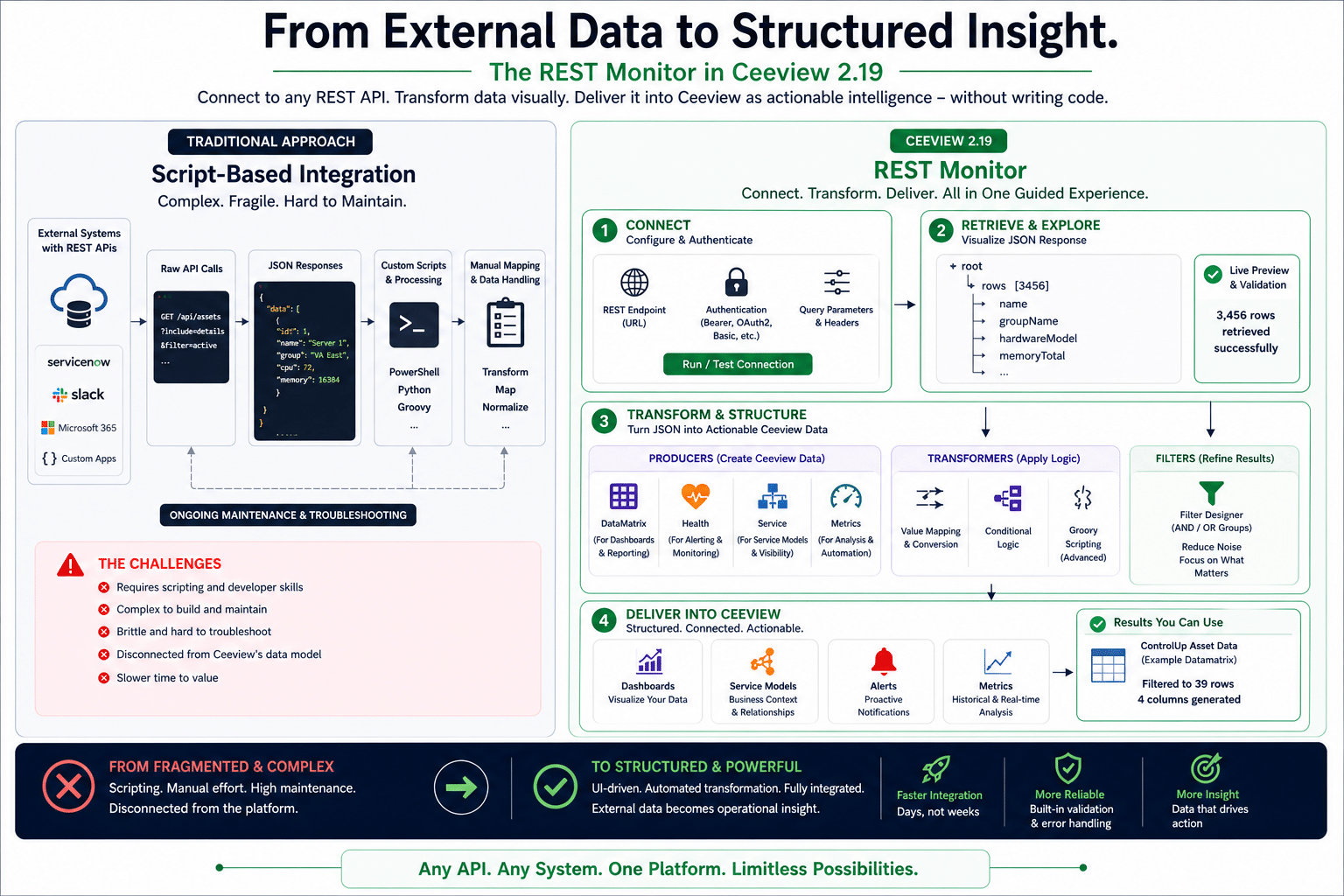
Four Ways to Turn API Data into Operational Insight
This is where the REST Monitor fundamentally differentiates itself.
At the center of this model is a concept called Producers—
a structured way to transform the same external data into multiple forms of operational intelligence.
Producers
Producers define how external data is shaped and what it becomes inside Ceeview.
From a single API connection, Ceeview enables four distinct ways to transform external data into operational insight—each aligned to a different outcome:
- Data Matrix Producer → structured datasets for dashboards and reporting
- Health Producer → health conditions and alerts
- Service Producer → dynamic service models and topology
- Metric Producer → time-series data for analysis and trending
All four Producers operate on the same underlying dataset—allowing a single API integration to be reused across multiple operational use cases.
At a glance, here’s how each Producer transforms the same data into different types of value:
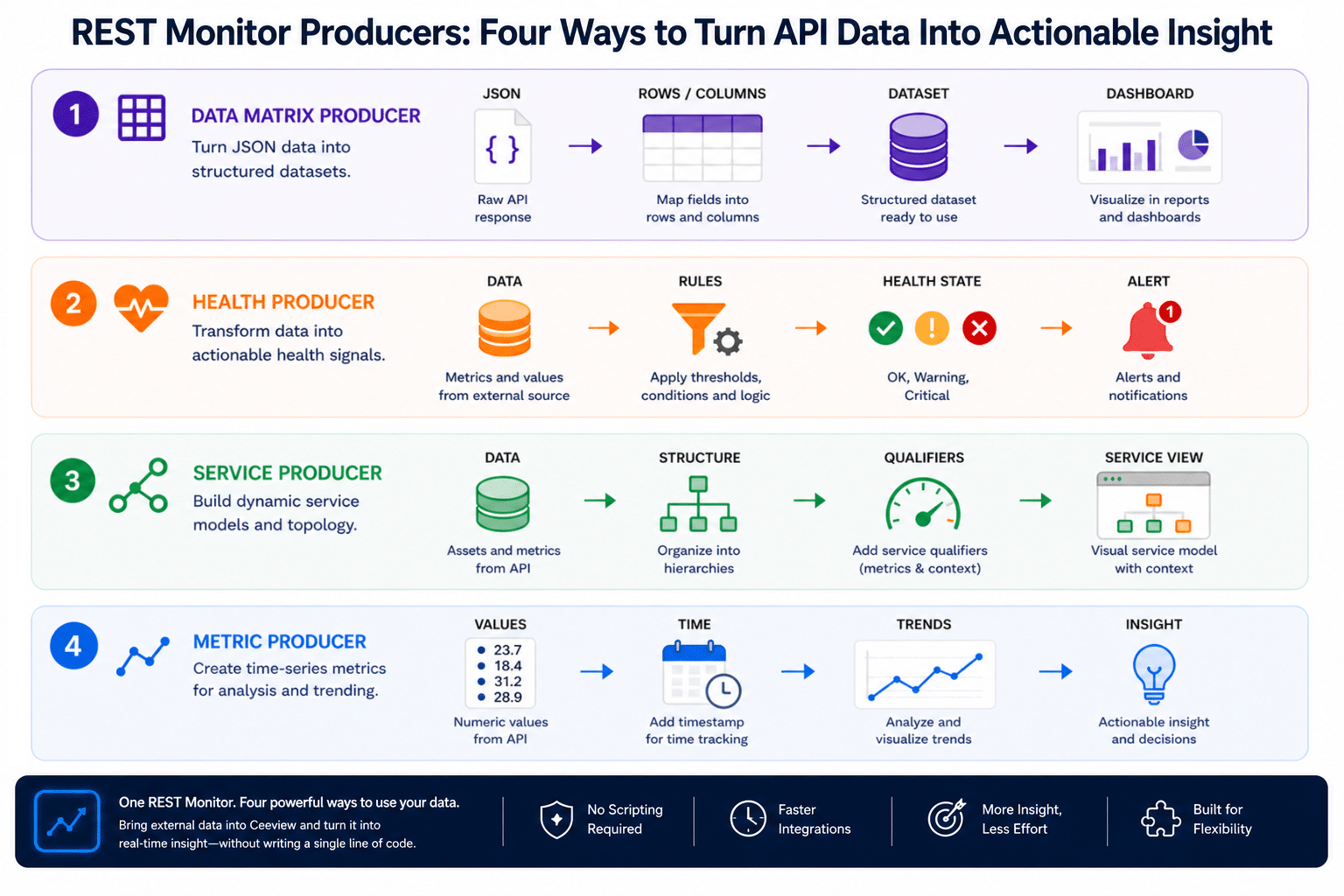
Data Matrix Producer: Structuring Data for Visibility
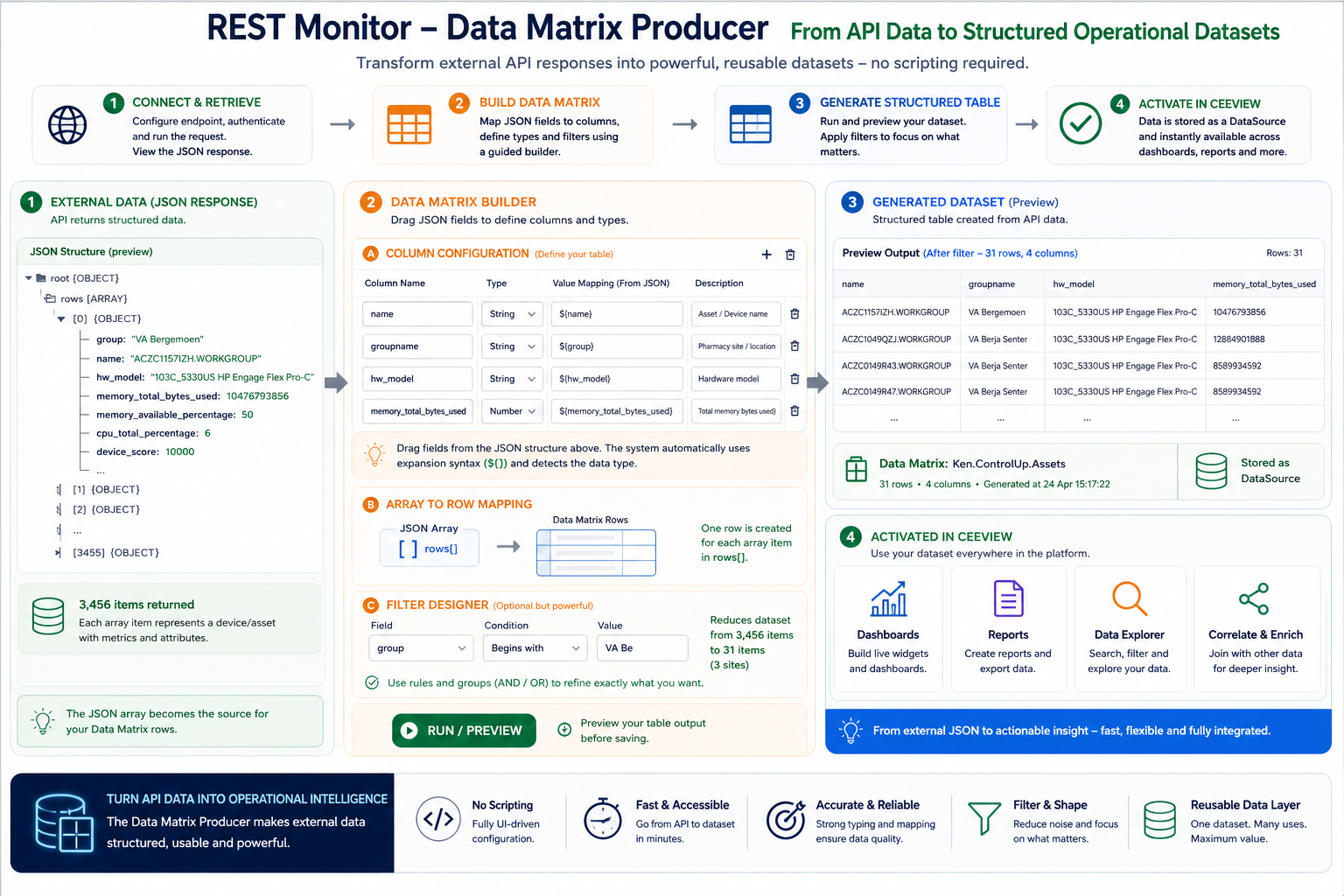
The Data Matrix Producer transforms API responses into structured datasets.
JSON fields are mapped into rows and columns, creating reusable tables that can power:
- Dashboards
- Reports
- Data exploration
- Cross-system analysis
This is often the first step in making external data usable—turning raw JSON into something structured, queryable, and shareable.
It provides a foundation layer for visibility across the organization.

For a deeper view, here’s how this works inside Ceeview:
Once data is structured, it can be interpreted.
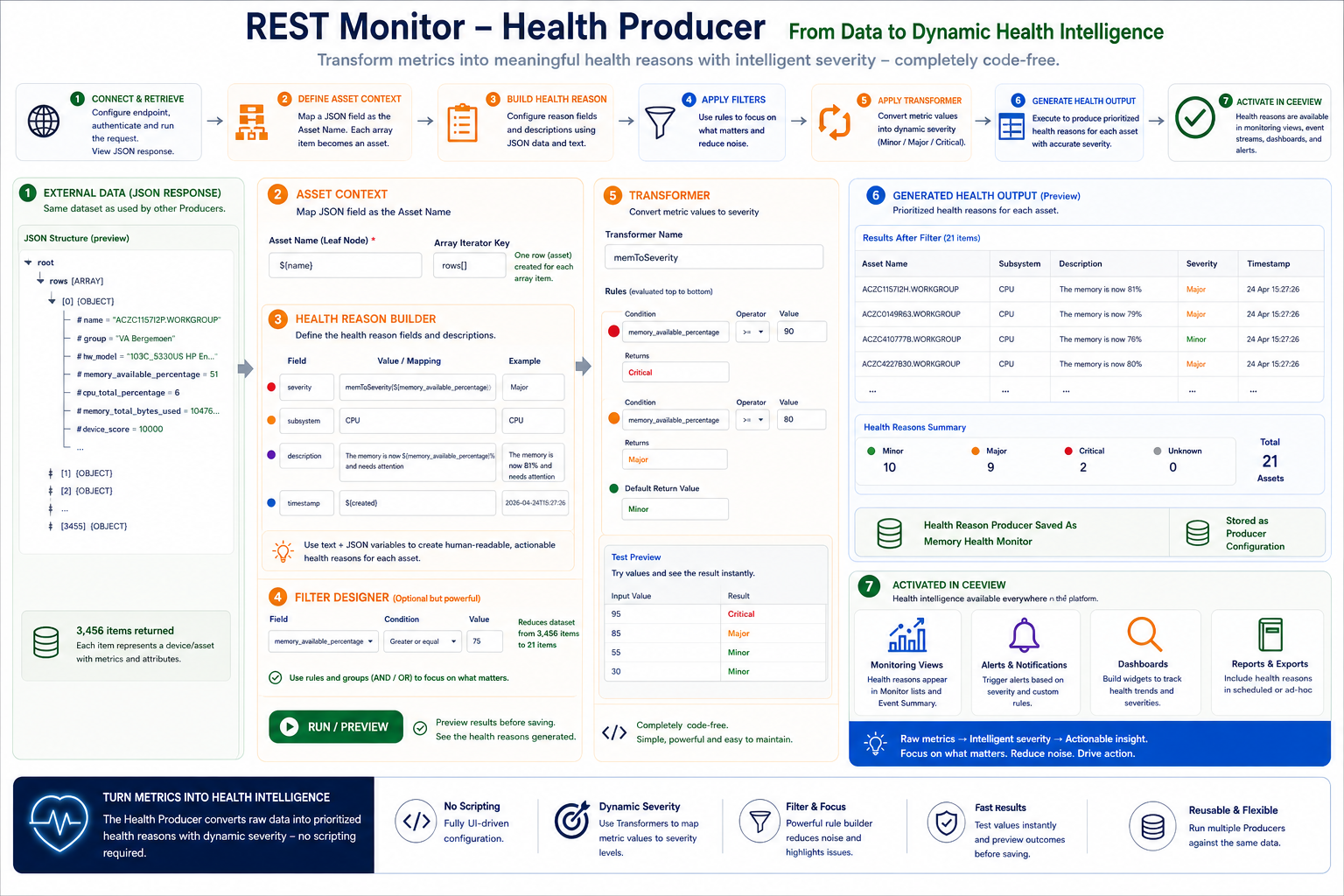
Health Producer: Turning Data into Actionable Signals
The Health Producer takes things further—transforming data into meaningful operational signals.
Using thresholds, conditions, and transformation logic, teams can:
- Define health states (OK, Warning, Critical)
- Generate human-readable health reasons
- Trigger alerts and notifications
- Reduce noise through intelligent filtering
Instead of just viewing metrics, teams gain contextual understanding of what matters and why.
This is where data begins to drive real-time operational awareness.

For a deeper view, here’s how this works inside Ceeview:
Beyond signals, organizations need context.
Service Producer: Building Business Context Through Topology
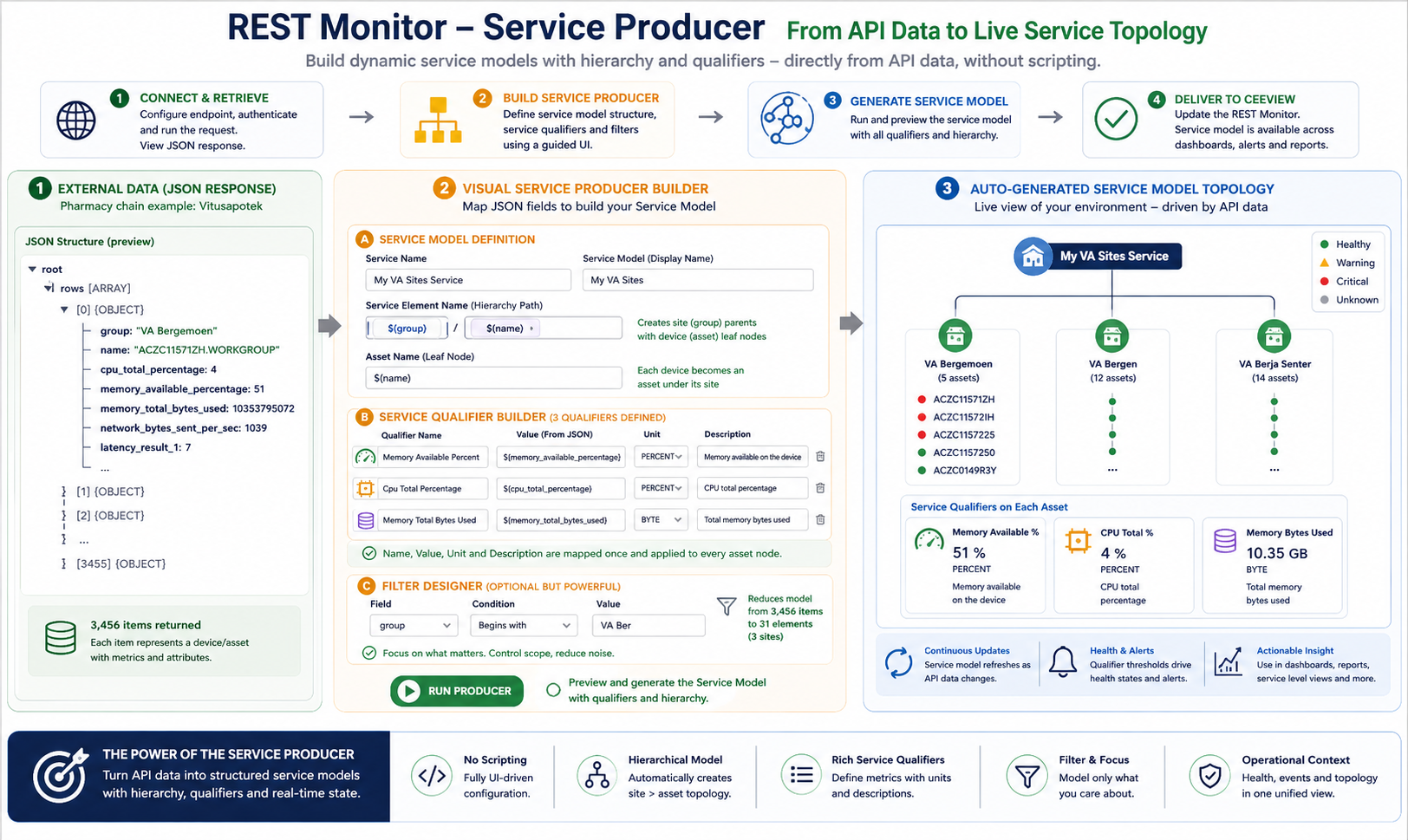
The Service Producer connects data to business context.
It uses API data to dynamically build service models, including:
- Hierarchical structures (e.g., site → system → component)
- Relationships between assets
- Service qualifiers—metrics like CPU, memory, or latency that are natively attached to each service node.
This creates a live representation of how systems support business services.
Rather than isolated metrics or alerts, teams see:
- How components relate
- Where issues impact services
- How performance ties to real-world operations
This is where observability becomes business-aligned visibility.

For a deeper view, here’s how this works inside Ceeview:
Alongside structure and context, teams need time-based insight.
Metric Producer: Enabling Time-Series Intelligence
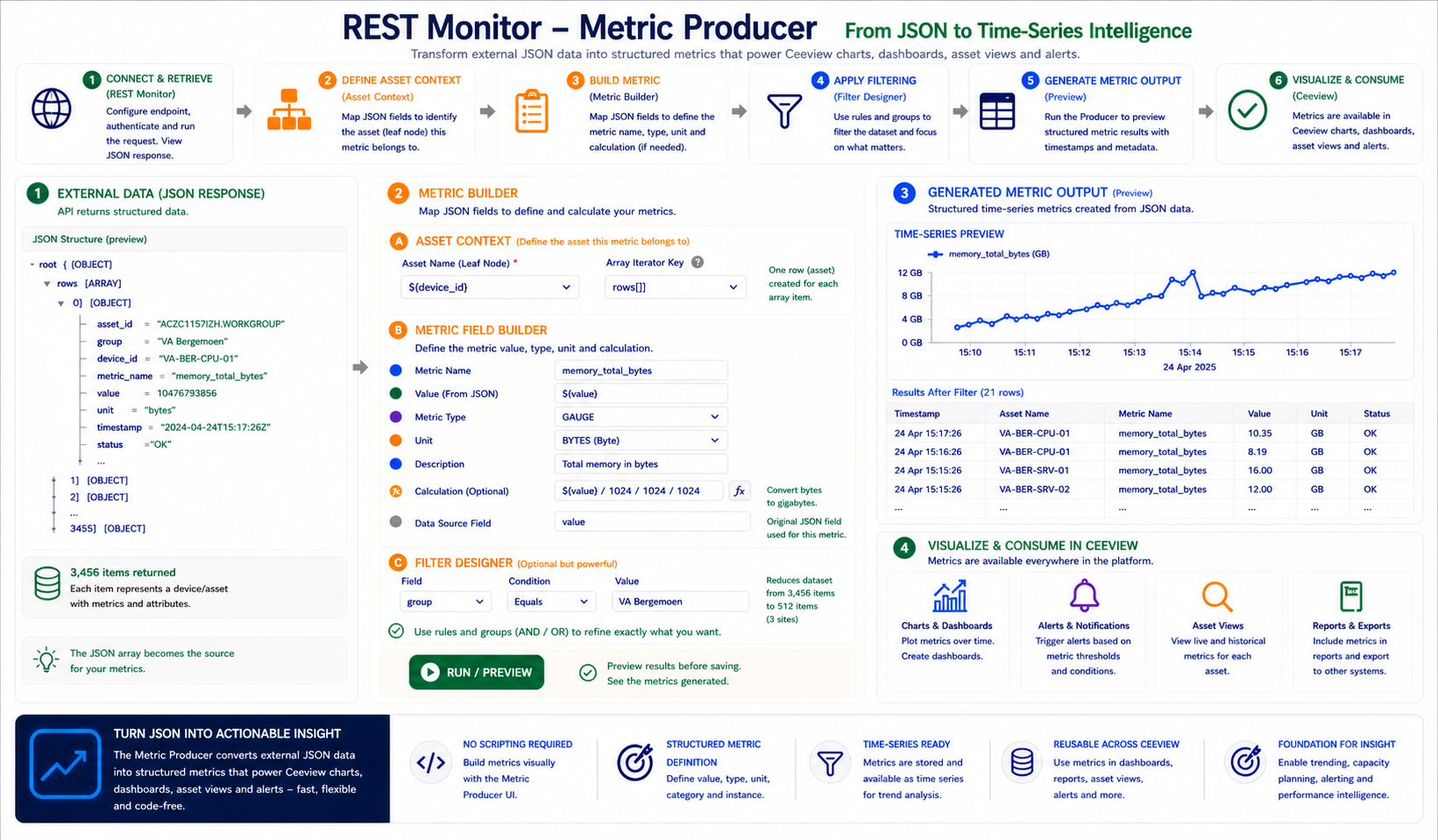
The Metric Producer focuses on numerical data and time-based analysis.
It transforms API values into structured metrics with:
- Defined names, units, and types
- Timestamps for time-series tracking
- Optional calculations and transformations
These metrics power:
- Trend analysis
- Capacity planning
- Performance monitoring
- Historical reporting
By converting raw values into time-series data, teams gain visibility not just into what is happening—but how it evolves over time.

For a deeper view, here’s how this works inside Ceeview:
From Integration to Intelligence
What makes the REST Monitor powerful is not any single capability.
It’s the combination of:
- A guided, no-code workflow
- A unified data model inside Ceeview
- Multiple Producers that shape data for different outcomes
This creates a shift:
What once required custom scripts, external pipelines, and ongoing maintenance is now handled within a single guided workflow.
From fragmented integration → to structured intelligence
External data is no longer something teams struggle to incorporate.
It becomes a natural extension of the platform—available for dashboards, alerts, service models, and analytics.
A New Standard for External Data in Observability
The REST Monitor establishes a new expectation:
- Faster integration without scripting
- Consistent transformation across use cases
- Reusable data across multiple views
- Alignment between technical data and business insight
Most importantly, it enables teams to move beyond simply collecting data.
They can now shape it, understand it, and act on it—within a single platform.
About the Author: