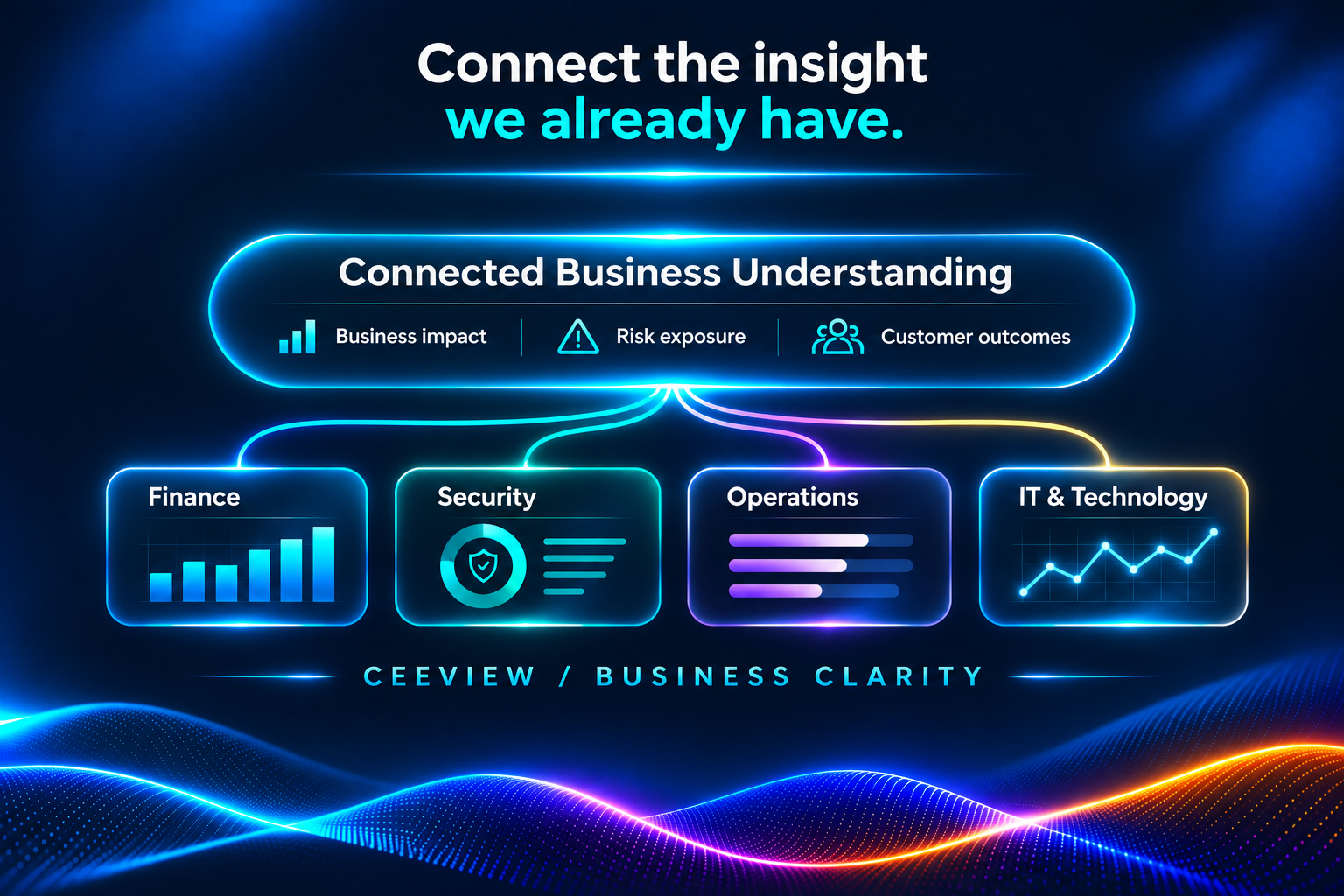
Organizations have never had greater access to information. Nor have they had more sophisticated technologies for turning that information into meaningful insight.
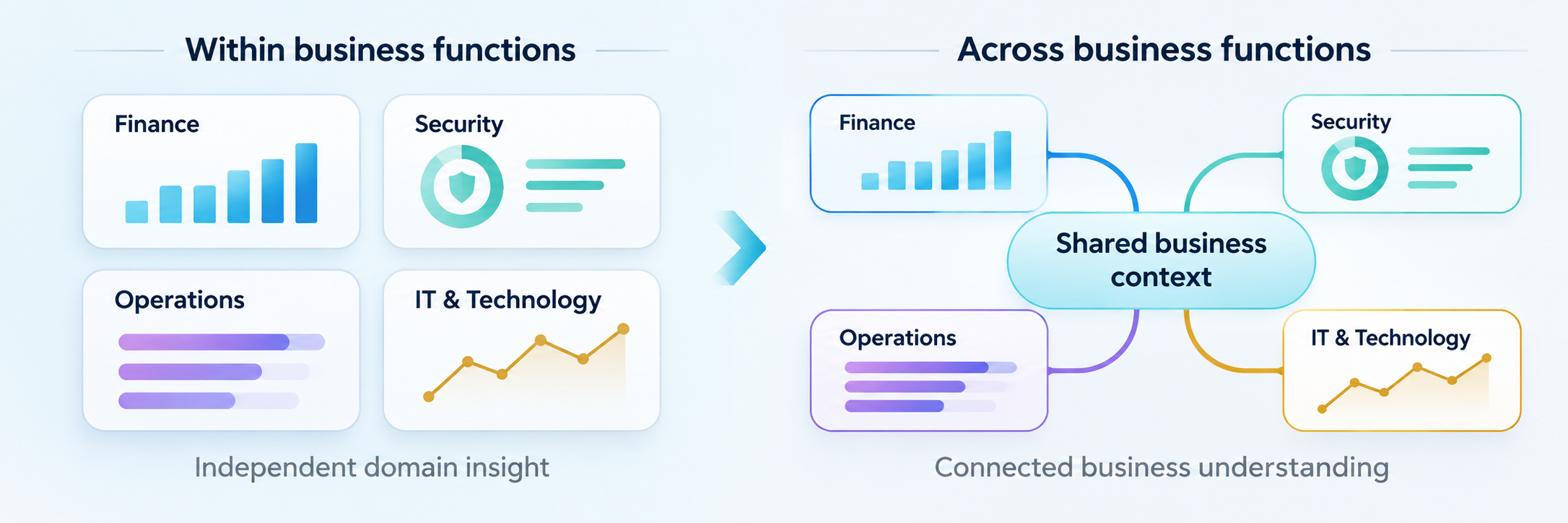
Financial teams continuously assess expenditure and financial performance. Security teams monitor threats, vulnerabilities and compliance. Operations teams track productivity, capacity and service delivery. IT teams understand the health and performance of increasingly complex technology environments.
Within individual areas of the business, continuous understanding is already a reality.
Yet ask a question that crosses several of these areas, and the experience can be remarkably different.
What is the business impact of a technology disruption? How does a change in customer demand affect operational capacity and cost? Are our technology investments delivering the business outcomes we expect? How does a security or compliance gap affect our ability to meet customer commitments?
Answering these questions can still require multiple systems, several teams and considerable manual effort.
From islands of insight to connected understanding
Over the years, organizations have invested in technologies designed to address specific business challenges. Many of these technologies do their jobs exceptionally well.
But the business itself does not operate in isolated domains.
Technology supports operations. Operations influence customer experience. Customer experience affects revenue. Security and compliance influence business risk. Financial decisions shape the resources available to all of them.
These relationships are fundamental to how a business performs, yet they are not always reflected in how the business is observed and understood.
An IT team may know that a service is experiencing performance degradation. An operations team may know that productivity is declining. A finance team may see an increase in operating costs.
Each has valuable insight. Connecting those insights can reveal a much more meaningful picture.
The opportunity is to build on the sophistication that already exists within these individual domains, connecting their insights through the context of the business they collectively support.
Start with what matters to the business
Conventional approaches to business intelligence often begin with data: collect it, organize it, analyze it and look for meaningful insights.
But what if we approached the challenge from the opposite direction?
What if we began by establishing what matters most to the business?
- Which business services are critical to success?
- What commitments have we made to our customers?
- What operational and financial outcomes are we trying to achieve?
- What risks could compromise those outcomes?
- What relationships and dependencies influence our ability to deliver?
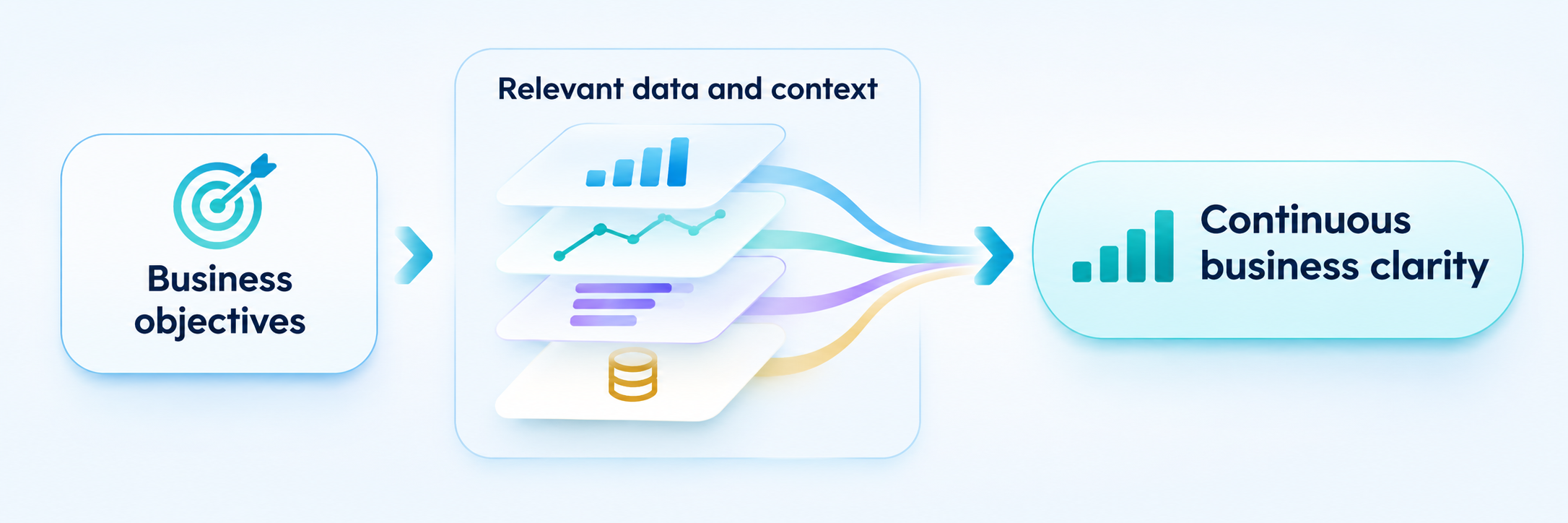
These questions provide a foundation for determining which information is relevant, how it should be connected and what it means in a business context.
Rather than asking what our data can tell us, we begin by asking what we need to understand about our business.
This is an important distinction.
Beyond real-time: decision-ready understanding
The ability to access information in real time is valuable, but speed alone does not necessarily lead to better decisions.
Information must also be trustworthy, relevant, contextual and actionable.
Understanding that something has changed is useful. Understanding what that change means to the business, who is affected and what response may be required is considerably more valuable.
Not every business decision requires instantaneous information. Different decisions operate on different timescales.
The objective should be to establish decision-ready understanding: having sufficiently current, reliable and meaningful information available when a decision needs to be made.
This shifts the emphasis from the speed of information delivery to the quality of business understanding.
Different perspectives. A common business reality.
A CEO, CFO, operations director and IT manager will naturally view the business from different perspectives.
Nor should we expect them to interpret every situation in the same way. Their responsibilities, priorities and decisions are different.
But those perspectives should be grounded in a common understanding of business reality.
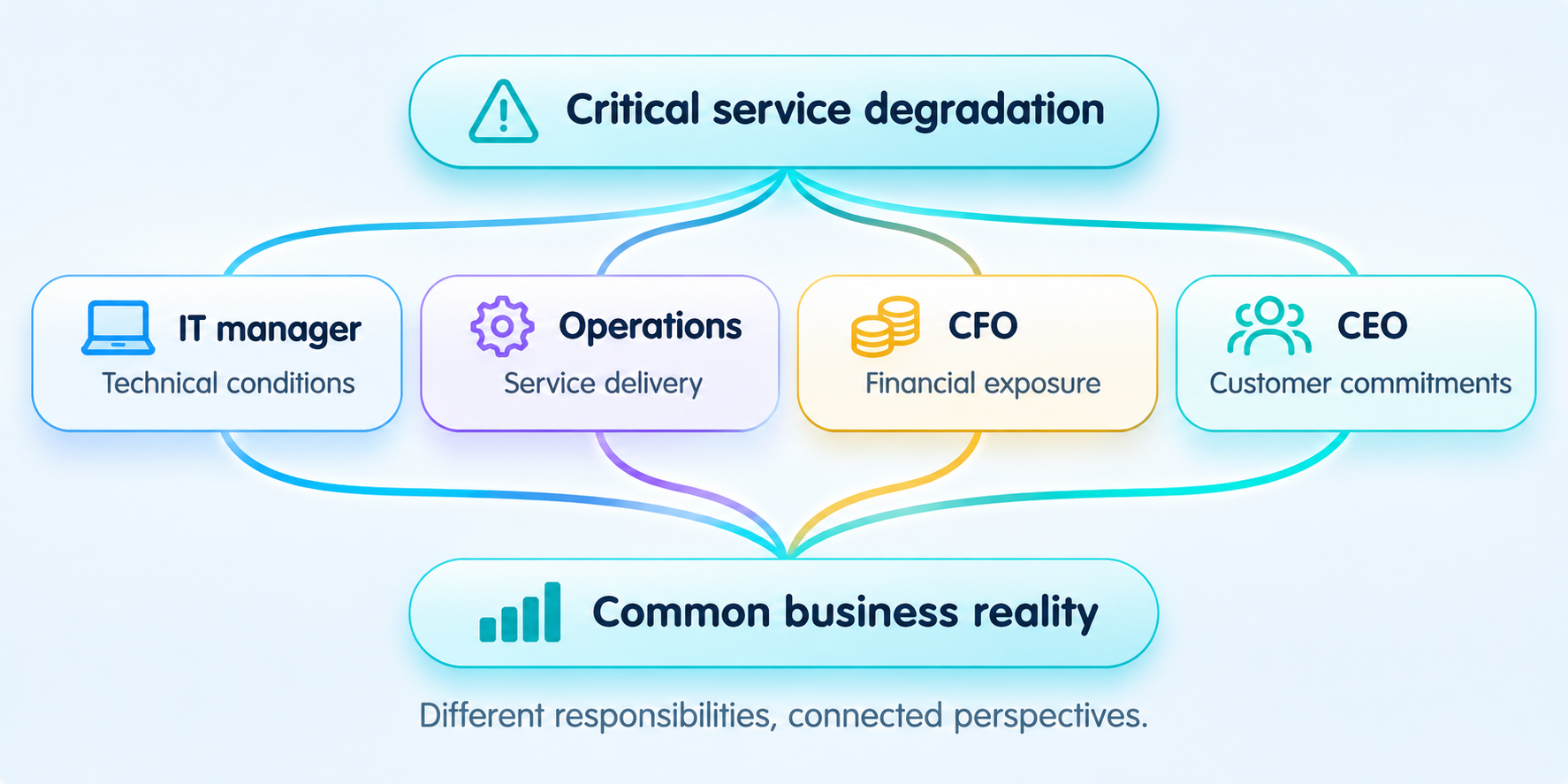
Consider a critical business service experiencing degradation.
The IT manager needs to understand the underlying technical conditions. The operations director needs to understand the impact on service delivery. The CFO needs to understand potential financial exposure. The CEO needs to understand the implications for customers and business commitments.
They do not necessarily need the same dashboard.
They need connected perspectives that reflect the same underlying business situation.
When organizations achieve this, the benefit extends beyond individual decision-making. Teams can align priorities, coordinate responses and collaborate with a greater understanding of how their respective actions influence the business as a whole.
Business clarity becomes an organizational capability rather than simply an analytical one.
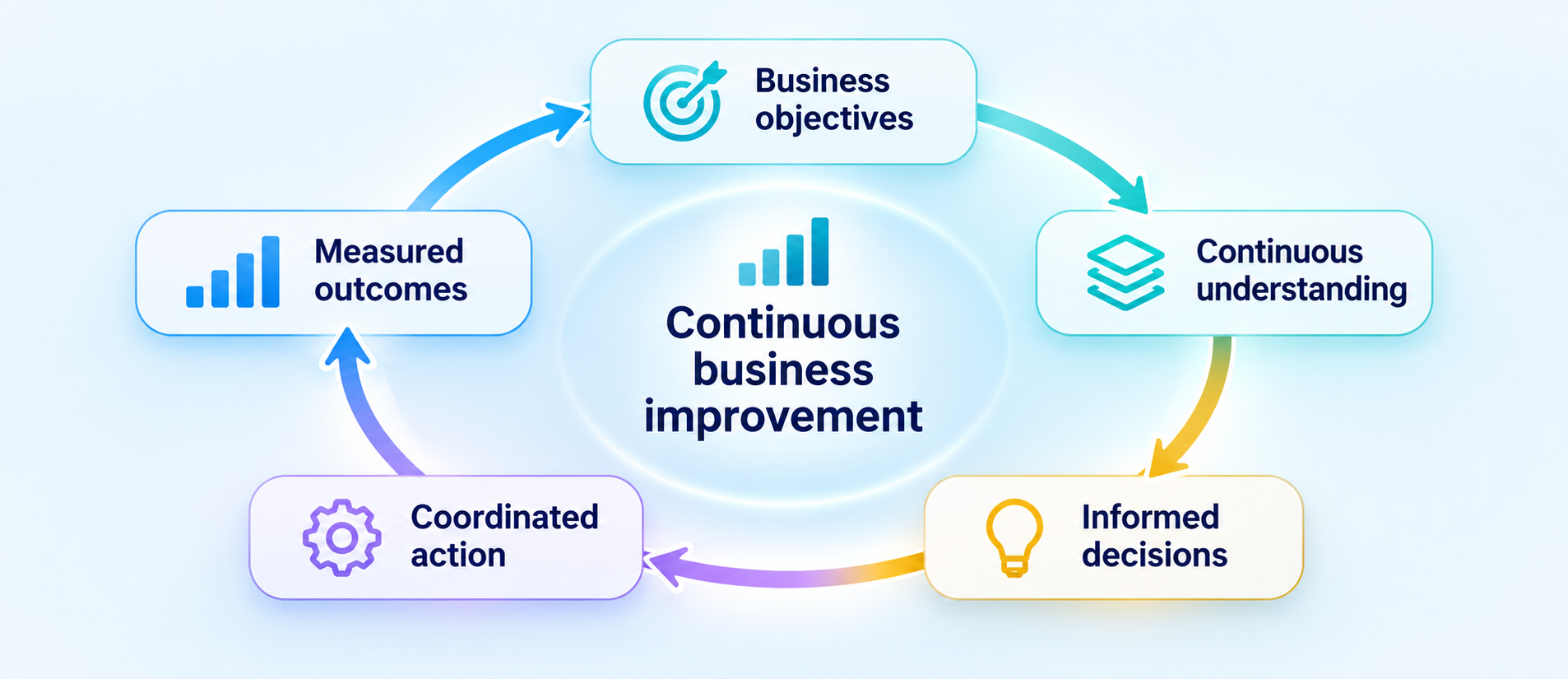
Closing the loop: from understanding to outcomes
Better understanding should lead to better decisions. But decisions are not the ultimate measure of success.
What happens after a decision is made?
Can we see whether the action taken is producing the intended result? Can we identify unintended consequences? Can we adjust our approach as business conditions change?
This is where continuous business clarity can become a foundation for continuous business improvement.
The outcomes themselves then inform our understanding, creating a continuous feedback loop.
Rather than periodically assessing business performance, organizations can develop an ongoing ability to understand how their decisions and actions are influencing it.
The value is not simply in knowing more about the business. It is in becoming better at running it.
Building on the technology investments already in place
Achieving connected business understanding does not necessarily require organizations to replace the technologies they already rely on.
In many cases, the information and insight needed to support better business understanding already exist across monitoring platforms, security tools, cloud environments, financial systems, service management platforms and operational applications.
The challenge is bringing that information together in a meaningful business context.
This is where Ceeview takes a business-led approach.
By connecting information from existing technologies and organizing it around business services, objectives, dependencies and outcomes, Ceeview helps organizations extend the value of their existing investments.
Whether understanding the business impact of technology performance, connecting cloud consumption to financial accountability, assessing compliance health or evaluating customer service commitments, the objective remains the same: make information meaningful in the context of the business.
Not another isolated source of insight, but a means of connecting understanding across the organization.
The next opportunity for business clarity
The evolution toward continuous business understanding is already well underway. Organizations have made substantial investments in the technologies, processes and expertise that enable it.
The next opportunity is to extend that understanding beyond individual systems, teams and business functions.
To connect what we know.
To understand how different parts of the business influence one another.
To enable people with different responsibilities to make decisions grounded in a shared understanding.
And to continuously assess whether those decisions are delivering the outcomes that matter.
Perhaps the greatest untapped value in our existing technology investments lies not within the individual insights they provide, but in the relationships between them.